







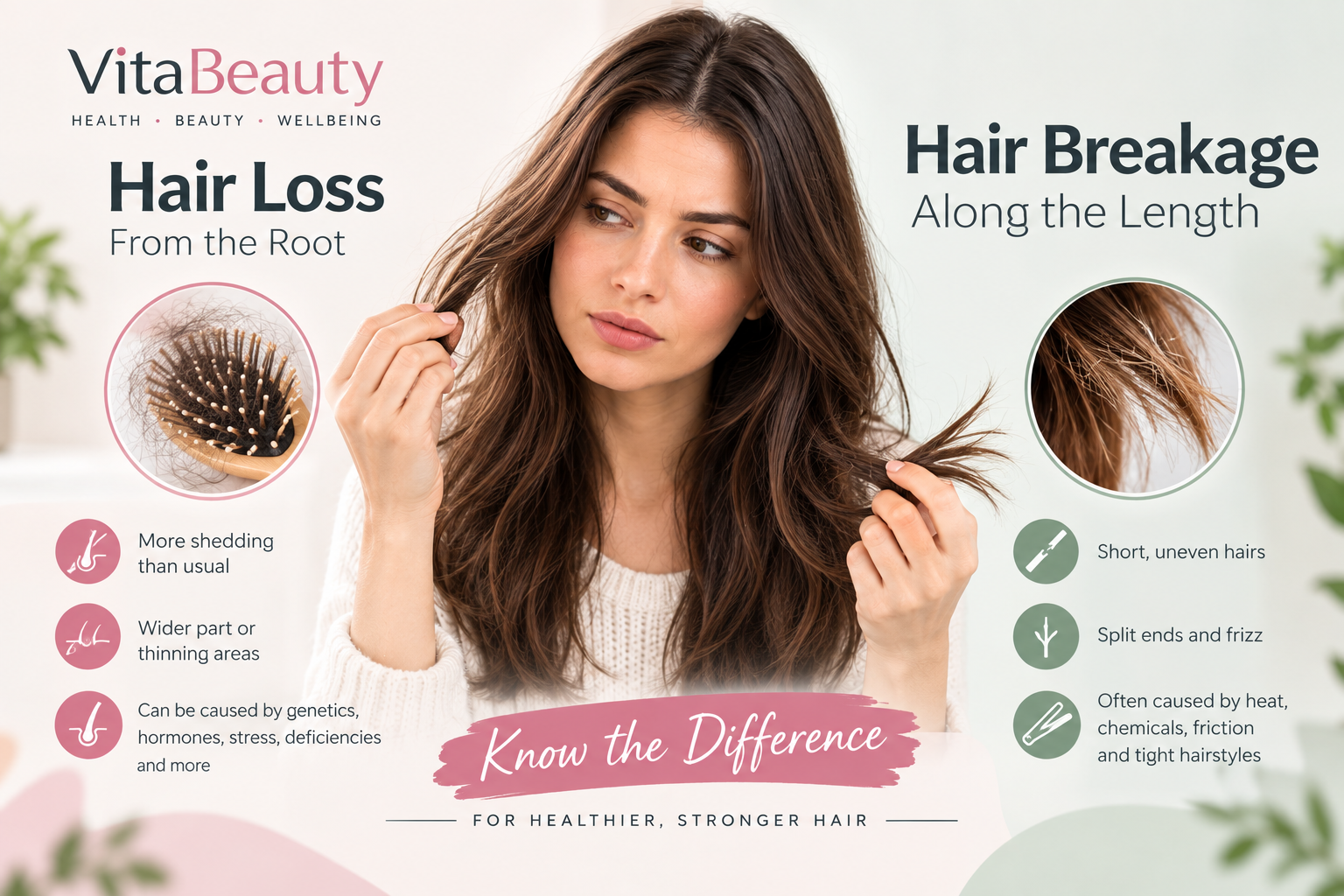
Hair Loss vs Hair Breakage: How to Tell the Difference
Seeing more hair than usual in your brush, shower or on your clothes can be worrying. But before assuming that you are experiencing hair loss, it is important to understand that hair loss and hair breakage are not the same thing.
Hair shedding happens when individual hairs naturally leave the scalp as part of the hair-growth cycle. Hair breakage, on the other hand, happens when the hair shaft becomes damaged and snaps somewhere along its length.
The two problems can look similar, and it is also possible to experience both at the same time.
Understanding the difference between hair loss vs hair breakage can help you identify what may be happening and choose a more appropriate hair-care routine.
If you are experiencing persistent or unexplained thinning, however, it is important not to assume that damaged hair is the only cause. Hair loss can have many causes, including genetics, stress, illness, nutritional deficiencies, hormonal changes and certain medical conditions.
What Is the Difference Between Hair Loss and Hair Breakage?
The simplest way to understand the difference is to consider where the hair is coming from.
Hair loss
Hair loss occurs when hair is shed from the scalp or when the normal hair-growth cycle is disrupted.
You may notice:
- Longer strands falling out
- More hair than usual in your shower
- A widening part
- A thinner ponytail
- More visible scalp
- Thinning around the crown or temples
- Bald or noticeably sparse areas
Hair loss can be temporary or progressive, depending on its cause.
Hair breakage
Hair breakage happens when the hair shaft snaps before reaching the end of its natural growth cycle.
You may notice:
- Short pieces of hair
- Uneven hair lengths
- Frizz
- Split ends
- Short hairs around the hairline
- Dry or brittle strands
- Hair that feels rough or weak
Breakage is often related to physical, chemical or heat damage.
However, persistent breakage can also make hair look thinner and may contribute to further hair damage.
Hair Loss vs Hair Breakage: Quick Comparison
| Hair Loss | Hair Breakage |
|---|---|
| Hair is shed from the scalp | Hair shaft snaps |
| Often involves longer strands | Often produces shorter pieces |
| May cause widening part or visible scalp | May cause uneven lengths |
| Can have genetic, hormonal or medical causes | Often associated with hair damage |
| May require medical assessment | Often improves with gentler hair care |
| Can sometimes be temporary or permanent | Damage can usually be reduced by changing hair-care habits |
The important point is that not every strand you find in your brush represents the same problem.
How to Recognise Hair Loss
Hair loss can develop gradually or suddenly.
The NHS notes that losing around 50 to 100 hairs per day can be normal. However, noticeable changes in density, persistent thinning or other unusual patterns may warrant further assessment.
1. Your Part Is Getting Wider
A widening central part can be an early sign of progressive thinning.
This is particularly relevant when the change develops gradually rather than appearing after a single episode of hair damage.
2. Your Ponytail Feels Thinner
If you regularly wear your hair in a ponytail, you may notice changes in its thickness over time.
A consistently smaller ponytail can indicate a reduction in overall hair density.
3. You Can See More of Your Scalp
If your scalp becomes increasingly visible through your hair, particularly around the top of the head, it may be worth investigating.
4. You Notice Increased Shedding
Finding some hair in the shower is normal.
However, a noticeable and persistent increase in shedding can sometimes occur after illness, significant stress, weight loss, hormonal changes or other triggers.
5. You Develop Bald Patches
Clearly defined patches of missing hair should not automatically be attributed to breakage.
There are several types of hair loss that can produce patches, and professional assessment can help determine the cause.
How to Recognise Hair Breakage
Hair breakage usually has a different appearance.
1. You See Lots of Short Hairs
If you notice many short strands that are significantly shorter than the rest of your hair, breakage may be contributing to the problem.
2. Your Hair Looks Frizzy and Uneven
Damaged hair can appear rough, frizzy or uneven.
The American Academy of Dermatology notes that damaged hair is fragile and tends to break, which can leave hair looking frizzy and unhealthy.
3. You Have More Split Ends
Split ends are a sign that the hair shaft has become damaged.
While trimming can remove existing split ends, reducing the behaviours that cause damage is important for preventing additional breakage.
4. Your Hair Feels Dry or Brittle
Hair that has been exposed to repeated heat, chemical processing or rough handling can become weaker and more prone to snapping.
5. You Notice Broken Hairs Around the Hairline
Short broken hairs around the forehead can sometimes be a sign of hair damage.
However, broken hairs around the hairline can also appear with traction-related hair loss, so context matters.
What Causes Hair Breakage?
There are many everyday habits that can weaken the hair shaft.
Excessive Heat
Frequent use of:
- Hair straighteners
- Curling irons
- Hot combs
- Hair dryers
can contribute to hair damage.
The American Academy of Dermatology recommends limiting heat styling and using lower temperatures where possible.
A better approach
Allow your hair to air dry when practical and use the lowest effective heat setting when styling.
Chemical Treatments
Frequent bleaching, colouring, perming, relaxing or chemical straightening can weaken the hair.
If you regularly use chemical treatments, spacing them out and having them performed professionally can help reduce unnecessary damage.
Rough Brushing
Aggressive brushing or pulling through tangles can put stress on the hair shaft.
Wet hair can be particularly vulnerable to breakage, although the best way to handle wet hair can vary depending on hair texture. The AAD recommends being gentle and avoiding unnecessary tugging.
Tight Hairstyles
Tight ponytails, buns, braids, cornrows, extensions and similar styles can put repeated tension on the hair.
This can cause both breakage and hair loss.
When repeated tension affects the follicles, it can lead to a type of hair loss known as traction alopecia. In advanced cases, the damage can become permanent.
Excessive Friction
Rough towel drying, aggressive brushing and other forms of mechanical friction can damage fragile hair.
Instead of rubbing your hair vigorously with a towel, gently wrap it and allow the towel to absorb excess water.
What Causes Hair Loss?
Unlike breakage, hair loss can originate from changes affecting the scalp, hair follicles or the hair-growth cycle.
Some possible causes include:
Genetics
Female pattern hair loss is a common cause of gradual thinning in women and can run in families.
Stress
Significant physical or emotional stress can sometimes be followed by increased shedding.
Illness
Some illnesses and periods of poor health can trigger temporary hair shedding.
Weight Loss
Rapid or significant weight loss can sometimes be associated with increased shedding.
Iron Deficiency
Iron deficiency can be associated with hair loss, particularly when it develops into iron-deficiency anaemia.
Hormonal Changes
Changes associated with pregnancy, after childbirth, perimenopause or menopause can affect hair growth and shedding.
Medical Conditions
Some scalp, autoimmune, hormonal or other medical conditions can cause hair loss.
This is why persistent thinning should not automatically be treated as simple hair damage.
Can Hair Breakage Cause Hair Loss?
This is where the distinction becomes more complicated.
Severe hair damage can make your hair appear thinner because strands are breaking before they reach their full length.
Repeated tension from hairstyles can also cause both breakage and a genuine type of hair loss.
The AAD explains that hairstyles that repeatedly pull on the hair can cause traction alopecia. If the pulling continues for long enough, the resulting hair loss can become permanent.
So while ordinary split ends and breakage are not the same as follicle-related hair loss, certain damaging habits can contribute to both problems.
Can Hair Loss and Breakage Happen at the Same Time?
Yes.
This is actually quite common.
For example, someone might have gradual genetic hair thinning while also using:
- Hair straighteners
- Bleach
- Tight hairstyles
- Extensions
- Frequent blow-drying
In this situation, the person could experience genuine hair loss from one cause while also experiencing breakage from hair damage.
This is one reason why simply changing shampoo may not solve persistent thinning.
How to Reduce Hair Breakage
If breakage appears to be part of the problem, focus on reducing damage.
Use a Gentle Shampoo
Choose a shampoo appropriate for your hair and scalp.
Avoid aggressively rubbing shampoo through the entire length of your hair. Dermatologists recommend focusing shampoo on the scalp and allowing the product to rinse through the lengths.
Condition After Washing
Conditioner can help reduce friction between hair fibres.
The AAD recommends using a moisturising conditioner after shampooing to help reduce breakage and split ends.
Be Careful With Wet Hair
Handle wet hair gently.
Avoid aggressive brushing or pulling through knots.
A wide-tooth comb or suitable detangling method can reduce unnecessary tension.
Reduce Heat Styling
Try to limit:
- Straighteners
- Curling irons
- Hot combs
- High-temperature blow-drying
When using heat, choose the lowest practical setting.
Avoid Constantly Tight Hairstyles
Give your hair regular breaks from styles that pull tightly.
If a hairstyle causes pain, stinging or significant tension on your scalp, it is too tight. The AAD recommends changing hairstyles when these warning signs occur.
How to Protect Thinning Hair
If you already have thinning or increased shedding, your hair may be more fragile.
The AAD recommends gentle washing and conditioning, limiting heat, avoiding harsh chemical treatments and reducing hairstyles that pull on the hair.
A simple routine could include:
- Gentle shampooing
- Conditioner after washing
- Careful detangling
- Limited heat styling
- Avoiding tight hairstyles
- Regular scalp observation
- Professional assessment if thinning continues
Does Hair Supplementation Help With Breakage?
Hair supplements and hair breakage address different issues.
If your hair is snapping because of excessive heat, chemical damage or mechanical stress, simply taking a supplement may not fix the underlying problem.
Nutritional deficiencies can contribute to some forms of hair loss, but supplements should not be viewed as a universal treatment for every hair concern.
If you want to learn more about ingredients commonly found in hair supplements, read:
Hair Growth Supplements: What Ingredients Should You Look For?
You can also read our guide to:
Vitamins for Hair Growth: A Guide to Key Nutrients
When Should You See a Healthcare Professional?
Consider speaking with a GP or dermatologist if:
- Your hair is suddenly falling out
- Your hair is rapidly becoming thinner
- You develop bald patches
- Your scalp is painful or inflamed
- You have persistent itching or scaling
- You notice a widening part that continues to progress
- Changing your hair-care routine does not improve the problem
- You are unsure whether you are experiencing hair loss or breakage
The NHS advises speaking with a GP if you are concerned about hair loss.
A professional can assess the pattern of hair loss and determine whether further investigation is appropriate.
A Simple At-Home Hair Check
If you are unsure whether you are experiencing hair loss or breakage, start by looking at the overall pattern rather than focusing on individual strands.
Check your part
Is it becoming wider?
Check your hairline
Are you seeing more scalp or many short broken hairs?
Check your ponytail
Does it feel noticeably thinner than it used to?
Look at the fallen hairs
Are you mainly seeing full-length strands or many short broken pieces?
Check the ends
Are they split, dry or uneven?
Think about recent changes
Have you recently:
- Changed your diet?
- Lost weight?
- Experienced significant stress?
- Been ill?
- Started a new medication?
- Increased heat styling?
- Coloured or bleached your hair?
- Started wearing tighter hairstyles?
These clues can help you understand what may be happening, although they cannot replace a professional diagnosis.
Hair Loss vs Hair Breakage: The Bottom Line
The difference between hair loss vs hair breakage is mainly about where and why the hair is being lost.
Hair breakage occurs when the hair shaft becomes damaged and snaps. It is often associated with heat, chemical treatments, friction, rough handling or repeated tension.
Hair loss involves the scalp and hair-growth cycle and can have many causes, including genetics, hormonal changes, illness, stress, nutritional issues and certain medical conditions.
You can also experience both at the same time.
The best approach is therefore not to automatically assume that every hair found in your brush represents a vitamin deficiency or a serious hair-loss condition.
Start with gentle hair care, reduce avoidable damage and pay attention to changes in your hair density and shedding pattern.
If thinning is persistent, sudden or unexplained, professional assessment can help determine what is actually causing the problem.
Frequently Asked Questions
How can I tell if my hair is breaking or falling out?
Look for patterns. Hair breakage often produces short, uneven hairs, split ends and frizz. Hair loss may cause increased shedding, a widening part, reduced density or visible scalp.
Is hair breakage the same as hair loss?
No. Hair breakage happens when the hair shaft snaps, while hair loss generally involves hair being shed from the scalp or a disruption of the hair-growth cycle.
Can damaged hair grow back?
Hair that has already broken cannot be repaired back into its original structure, but new hair can grow from healthy follicles. Reducing further damage can help the hair appear healthier as it grows.
Can heat styling cause hair loss?
Excessive heat can damage the hair and increase breakage. Repeated tension from hairstyles can also cause traction alopecia, which is a genuine form of hair loss.
Does brushing cause hair loss?
Rough or excessive brushing can cause mechanical damage and breakage. Gentle brushing and detangling can help reduce unnecessary stress on the hair.
Can tight hairstyles cause permanent hair loss?
Yes. Repeated tension from tight hairstyles can cause traction alopecia. If the tension continues for a long time, the resulting hair loss can become permanent.
Should I take vitamins if my hair is breaking?
Not necessarily. Breakage is often related to physical or chemical damage rather than a vitamin deficiency. If you also have unexplained thinning or shedding, speak with a healthcare professional before assuming that supplements are the answer.
What is the best way to prevent hair breakage?
Use gentle hair care, condition after washing, reduce heat styling, avoid aggressive brushing and minimise chemical treatments and tight hairstyles.
When should I see a doctor about hair loss?
Speak with a GP or healthcare professional if you are concerned about hair loss, especially if it is sudden, severe, rapidly progressing or accompanied by other symptoms.
Medical Disclaimer: This article is for general informational purposes only and does not replace professional medical advice, diagnosis or treatment. If you are experiencing persistent, sudden or unexplained hair loss, speak with a qualified healthcare professional.


